Loading…
Venue: Colorado A clear filter
arrow_back View All Dates
Wednesday, September 16
 

09:00 MDT

Awaiters and Awaitables
Wednesday September 16, 2026 09:00 - 10:00 MDT
C++20 coroutines come with a reputation for complexity — and writing your own coroutine return type deserves that reputation. But here is the good news: you probably don't have to. With std::generator in C++23, high-quality libraries like Asio and cppcoro today, and std::task on its way in C++26, most developers can simply write co_await and move on.

There is one gap, however. Sooner or later, every developer using coroutines needs to bridge an existing asynchronous interface — a timer, an I/O operation, a thread pool callback, a legacy future — into the coroutine world. That bridge is built with awaiters and awaitables, and that is exactly what this session teaches.

We will start from first principles: what does co await actually do? We will demystify the three functions that form the awaiter protocol — await ready, await suspend, and await resume — and build a clear mental model for each. We will implement a real awaiter from scratch, then explore how symmetric control transfer keeps the call stack flat across deeply chained async operations. Next, we will learn how to make any existing type co await-able without modifying it, using operator co await, and how await transform lets you restrict or adapt awaitable behavior to a specific coroutine context. Finally, we will look at how to write cancellation-aware awaiters using std::stop token, so your coroutines respond promptly when work is no longer needed.

No prior coroutines experience is assumed. If you know what co await looks like on the surface but not what happens underneath it, this session is for you. You will leave with both the knowledge and the code to wrap any asynchronous operation into a first-class co await expression.

Presenters
avatar for Mateusz Pusz

Mateusz Pusz

C++ Trainer, Train IT
Mateusz Pusz is a C++ architect and voting member of the ISO C++ Committee (WG21), with 100% meeting attendance since 2017. As an active contributor to Library Evolution, he originated variable template template parameters (P2008, now part of C++26), co-authored heterogeneous lookup... Read More →
Wednesday September 16, 2026 09:00 - 10:00 MDT
Colorado A

10:30 MDT

How C++26 changes the way we write code
Wednesday September 16, 2026 10:30 - 12:00 MDT
The upcoming C++26 Standard is a major update of the language and one of the most impactful releases in the history of C++.

std::simd transforms high-performance C++ by raising vectorisation to a portable standard abstraction. The new sender/receiver execution library provides a powerful generic framework that redefines asynchronous programming in C++. Contract assertions introduce scalable and configurable correctness checks for identifying program defects and making C++ code safer. Finally, reflection – the most eagerly anticipated feature of C++26 – profoundly reshapes how we reason about C++ and what we can accomplish with it.

This talk is the third installment in a popular series exploring how each new C++ Standard changes the way we write code – from everyday idioms to advanced patterns – with a practical focus on what matters most to real-world developers. This is not a firehose talk that tries to cram as many additions to the latest Standard as possible into one hour. Instead, we focus deliberately on just a handful of particularly impactful features and highlight the essential ideas every C++ developer needs to understand.


Presenters
avatar for Timur Doumler

Timur Doumler

Senior Software Engineer, Citadel Securities
Timur Doumler is a software engineer specialising in low-latency and real-time C++. He works at Citadel Securities and is an active member of the ISO C++ standard committee, where he has (co-)authored many successful proposals including [[assume]], std::inplace_vector, and contract... Read More →
Wednesday September 16, 2026 10:30 - 12:00 MDT
Colorado A

14:00 MDT

Rule of 0,1,2,5,6,7,8,9,10?
Wednesday September 16, 2026 14:00 - 15:00 MDT
As of C++11 there are 6 special member functions that the compiler will generate for us if we don't do anything to get in the way.

But there are many other member functions, in the form of comparison operators, that we can =default explicitly

Which of these should we =default? How do we help the compiler, or stay out of its way?

How many do we need to implement? When can you trust the compiler or not?A

Presenters
avatar for Jason Turner

Jason Turner

Sole Proprietor, Jason Turner
Jason is host of the YouTube channel C++Weekly, co-host emeritus of the podcast CppCast, author of C++ Best Practices, and author of the first casual puzzle books designed to teach C++ fundamentals while having fun!
Wednesday September 16, 2026 14:00 - 15:00 MDT
Colorado A

15:15 MDT

Queue Discipline: A Deep Dive into Lock-Free SPSC, MPSC, SPMC, and MPMC Queues in Modern C++
Wednesday September 16, 2026 15:15 - 16:15 MDT
Queues are the backbone of concurrent systems — yet most C++ developers treat them as a black box. Pick the wrong queue topology, misplace an alignas, or use the wrong memory order, and you pay for it in microseconds of latency, invisible cache thrashing, or subtle correctness bugs that only manifest under load. This talk is a rigorous, bottom-up treatment of the four canonical concurrent queue topologies: SPSC, MPSC, SPMC, and MPMC. We start with the hardware reality — how cache coherence protocols turn innocent struct layout into a performance disaster through false sharing — and build upward through the C++ memory model, atomic operations, and queue algorithm design. For each topology, we derive the minimal set of memory ordering guarantees required for correctness, show how to exploit producer/consumer asymmetry to eliminate unnecessary synchronization, and demonstrate how alignas(std::hardware destructive interference size) and deliberate padding can be the difference between 100ns and 10ns throughput. We dissect Dmitry Vyukov's MPMC ring buffer, the intrusive MPSC queue, and Michael-Scott's linked-list queue — not just their interfaces, but the why behind every memory order acquire and every phantom cache line. We then go beyond correctness into the practical engineering tradeoffs: bounded vs unbounded, throughput vs latency, contention vs coordination overhead. Real benchmark data shows how these decisions interact non-obviously — an MPMC queue can outperform MPSC under certain producer counts, and seq cst where you don't need it can quietly halve your throughput. Attendees will leave with a clear mental model for choosing and implementing the right queue for their threading topology, a checklist for false sharing audits, and battle-tested code patterns suitable for low-latency production systems.

Presenters
avatar for Anmol Singhal

Anmol Singhal

Gardening, My garden
Anmol has spent 5 years working as a quantitative developer at Goldman Sachs and IMC trading. Previously he completed his education from NYU and BITS Pilani. Most recently he developed multi threaded applications for trading application and improved software performance. He errs on... Read More →
Wednesday September 16, 2026 15:15 - 16:15 MDT
Colorado A

16:45 MDT

Modern C++ Techniques to Reduce Boilerplate Without Sacrificing Performance
Wednesday September 16, 2026 16:45 - 17:45 MDT
Modern C++ gives developers powerful tools to write cleaner, safer, and more expressive code — but many production codebases still suffer from excessive boilerplate, repetitive patterns, and verbose implementations inherited from older C++ styles.

This talk explores practical modern C++ techniques that significantly reduce lines of code while preserving readability, maintainability, and runtime performance.

Through real-world examples, we will refactor traditional C++ implementations using features such as ranges, structured bindings, constexpr, concepts, CTAD, lambdas, std::optional, std::variant, and std::expected. We will examine where these features genuinely improve code quality — and where they can accidentally hurt clarity or performance if misused.

The session also goes beyond syntax improvements by analyzing generated assembly, compiler optimizations, allocations, and benchmark results to validate whether “shorter” code truly remains zero-cost.

Attendees will leave with practical patterns they can immediately apply to modernize existing codebases, reduce unnecessary complexity, and write more expressive C++ without sacrificing performance.

Presenters
avatar for VISHNU G NATH

VISHNU G NATH

Software Technical Lead, Applied Materials
Seasoned software developer with over 8 years of experience specializing in modern C++ development across industrial automation, semiconductor manufacturing, and enterprise systems. He currently works as a Technical Lead Software at Applied Materials, where he architects and implements... Read More →
Wednesday September 16, 2026 16:45 - 17:45 MDT
Colorado A

18:15 MDT

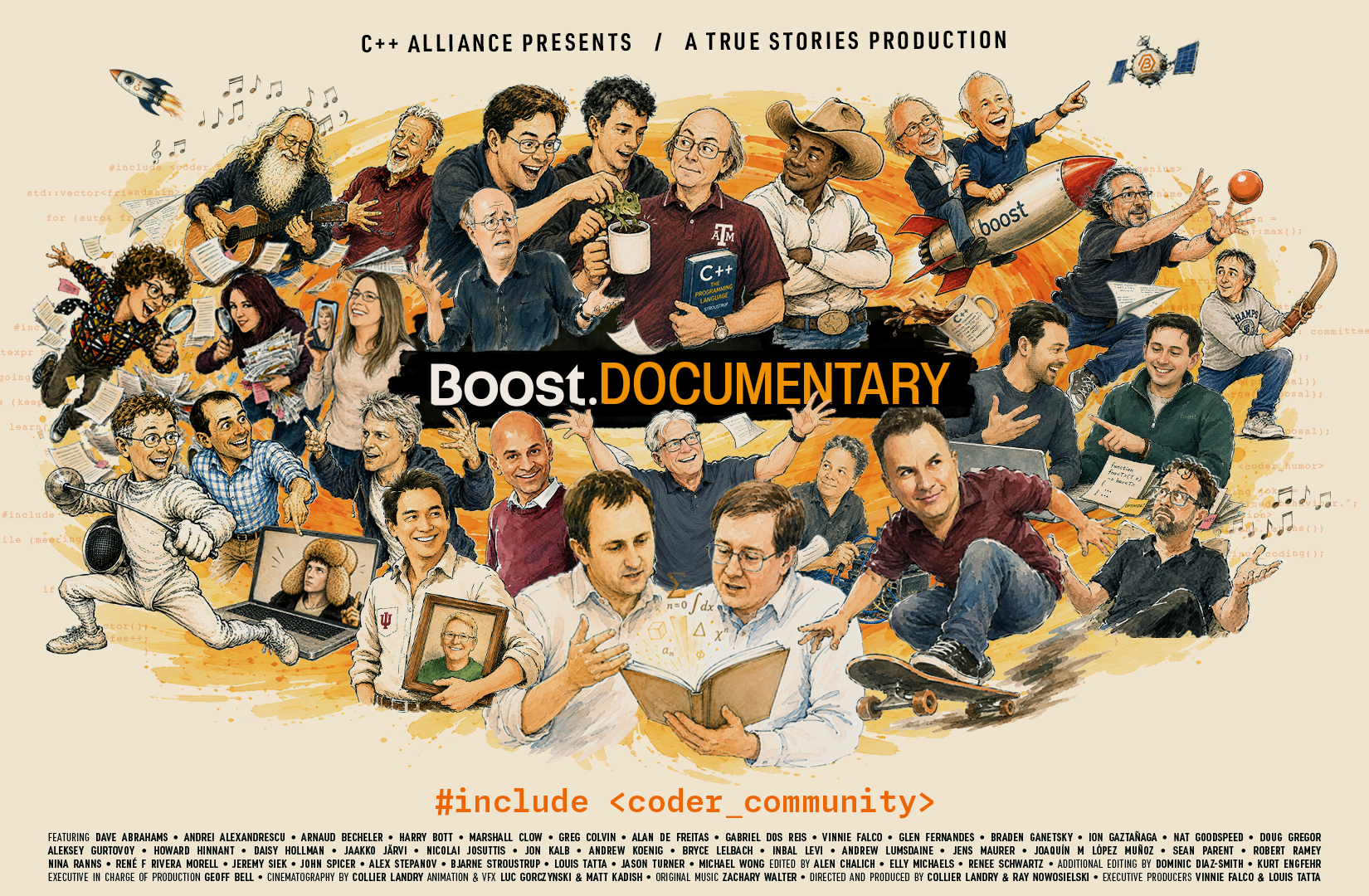
Boost.Documentary (Audience Preview Screening)
Wednesday September 16, 2026 18:15 - 21:00 MDT
Boost has always been run by its community. Nothing got in without review, nobody's library was above being argued. The Boost.Documentary filmmakers want their film held to the same standard. Join the test screening and ensure your thoughts are reflected in the general release cut!

The True Stories team will be on site during this Audience Preview Screening.

True Stories is the two-time Image Award-nominated production company of Collier Landry and Ray Nowosielski. They met on the production of A Murder in Mansfield, bringing to life Landry’s personal story for Warner Discovery, and have since together and solo led the productions of Emmy- and awards-nominated documentaries, including 1946: The Mistranslation that Shifted Culture, Desert One (HISTORY), Gumbo Coalition (HBO Max), Reservation Redemption, The Super Models (AppleTV), and Tricky Dick and the Man in Black (Netflix), and podcasts, including After the Uprising (iHeartMedia), The Collier Landry Show (YouTube), Finding Mom’s Killer (Sony/The Binge) and Moving Past Murder (YouTube).


Wednesday September 16, 2026 18:15 - 21:00 MDT
Colorado A
 
Share Modal

Share this link via

Or copy link

Filter sessions
Apply filters to sessions.
Filtered by Date -